


Introduction
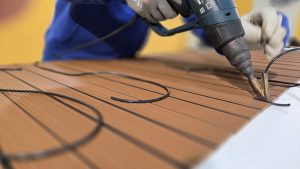
Hot welding of synthetic PVC teak profiles ensures seamless, waterproof, and reliable joints
Heat welding is one of the key technologies used in the installation of PVC-based artificial teak deck coverings. Welding allows for a monolithic connection between profiles or panels, ensuring high strength, tightness, and durability of the deck in marine conditions.
In this article, we will examine how PVC teak hot welding works, when it is necessary, and what problems arise in practice.
What is heat welding of PVC teak?
Hot welding is a process of joining PVC profiles or panels by locally heating the joints to a plastic state while simultaneously adding a welding cord heated to its melting point and forming a weld.
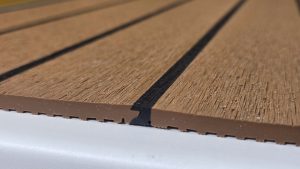
This is what a heat welded seam looks like on Isoteak’s artificial teak system.
During the welding process:
- the profile and welding cord material softens,
- PVC diffusion occurs between the elements,
- after cooling, a single structure is formed without an adhesive layer.
In fact, when done correctly, welding creates a monolithic seam that is comparable in strength to the base material.
Artificial teak welding is performed manually using a simple set of tools, the main one being a hot air gun with a maximum temperature of 600 degrees and a power from 2 kW.
There are two main types of PVC welding:
– Top welding
This involves welding profiles from the front (top) side, followed by grinding the welded seams. Welding can be done directly on the boat deck after the profiles have been glued on the deck. This method is purely professional, requiring great accuracy, training, and a lot of practice, so it is used only by professionals when manufacturing complex parts or decorative elements. In addition, grinding welded seams requires additional time.
– Backside welding
This method uses profile systems with a precisely manufactured groove for the welding cord. Such profiles are used by most manufacturers of artificial teak. This method is much simpler; you can learn hot welding of PVC in a few hours, and after welding a few square meters, you can obtain professional-quality products. However, for back welding, systems from different manufacturers require different numbers of additional tools. For example, Flexiteek systhem welding requires many different stops and weights, while Isoteak offers a system with an adhesive lock and subsequent welding, which requires only a couple of additional simple tools and is accessible to DIY enthusiasts.
The difference between hot welding and adhesive bonding
PVC is a material with relatively low surface energy, which makes it difficult for adhesives to “stick” to its surface. Even rigid PVC requires special preparation (cleaning, primers, activators), otherwise the adhesive bond will be unstable. In the case of soft PVC, the situation is complicated by the fact that it contains additives that provide elasticity. Therefore, adhesive bonding of both rigid and soft PVC is often less reliable in the long term compared to thermal bonding methods.
Adhesive bonds surfaces, while hot welding bonds the material itself.
In practice, both methods are used in PVC decking installation, but for different tasks.
| Hot welding is preferable if: | Adhesive bonding is acceptable if: |
|---|---|
|
|
It is important to understand that some of the professional systems, such as ISOTEAK PRO DECK, combine both methods.
Of course, welding PVC profiles for the deck is the preferred method and is more reliable, but it requires a more professional approach, as well as additional accessories and tools. That is why hot welding is used as standard in professional deck systems, while DIY solutions often offer compromise options that simplify installation.
Key problems with hot welding of PVC-Teak
Despite its obvious advantages, hot welding requires strict adherence to the technology. Below are the main problems encountered in practice.
1. Incorrect welding temperature
One of the most common mistakes is incorrect temperature control.
| Too low temperature: | Too high temperature: |
|---|---|
|
|
Each type of PVC tile has its own optimal temperature range.
2. Material incompatibility
For high-quality welding:
- the welding cord must be made of the same PVC composition as the base material;
- the use of universal or “foreign” cords is unacceptable.
- Incompatibility leads to:
- weak joints,
- microcracks,
- accelerated seam degradation.
3. Lack of operator experience
Hot welding is not only about temperature, but also:
- speed of movement,
- pressure,
- welding cord feed angle,
- uniformity of heating.
Operator error leads to a visually “beautiful” but structurally weak weld.
Using the Isoteak system
The Isoteak Pro Deck system includes a universal three-layer PVC profile with a lock joint, which allows you to glue the profiles without welding, or weld already glued panels using the back welding method.
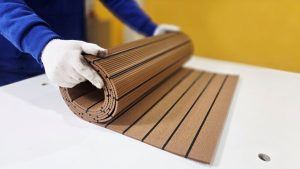
DIY enthusiasts and professionals can use pre-welded Isoteak Pro Deck sheets for their projects.
A key feature of Isoteak systems is that both DIY enthusiasts and professionals can use pre-welded sheets for their projects. You can cut frameless panels from the sheets using a template, or you can frame them with a border profile by gluing it to the main part.
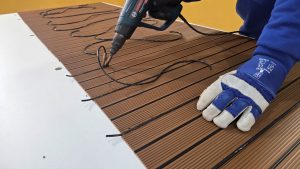
Heat welding process of Isoteak PVC teak decking panels during manufacturing
Hot welding of Isoteak three-layer profile panels requires a minimum of tools. You will need a heat gun, a set of nozzles for welding and heating, a fixing element for the starting strip, and a knife for cutting the cord. The materials required are welding cord and adhesive. The recommended adhesive comes with the roll of material. The process of gluing and subsequent welding requires a short learning curve and can be mastered even by DIY enthusiasts after some practice.
For a practical demonstration of panel assembly using adhesive bonding and hot air welding, see the step-by-step video tutorial: Gluing and Hot Welding PVC Synthetic Teak Panels
All welding accessories are available in the Isoteak online store.
FAQ
How artificial PVC teak is welded
Artificial PVC teak is welded with hot air using a special welding cord through a special nozzle. During the welding process, the cord is heated to its melting point and diffuses with the profiles being joined, forming a monolithic joint.
Can PE cord be used for welding?
No, the cord must not only be made of PVC, but also be suitable for a specific artificial PVC tick system, as each system has its own parameters and welding temperature.
At what temperature does PVC teak melt?
The melting point depends on each system. The surface of PVC teak can be damaged even at a temperature of 100 degrees Celsius if a small area is exposed to hot air for a long time. However, it can withstand much higher temperatures of up to 400 degrees Celsius for short periods of time.
What temperature is required for welding PVC teak?
When hot welding PVC profiles, it is important to maintain uniform heating to a level at which the material becomes plastic without overheating. This approach ensures a diffuse connection of the material, rather than just a surface connection. Each PVC decking system may have its own welding mode. For the Isoteak Pro Deck synthetic PVC teak decking system, the welding temperature can vary from 470 to 530 degrees. The temperature is selected depending on the welding speed and the hot air flow rate.
Why did the cord not weld to the profiles when welding PVC teak?
There may be several sources of this problem. The main one is the temperature mismatch during welding. At low temperatures, diffusion does not occur, and at high temperatures, the cord becomes brittle and the joint breaks down.
Understand the physics of the process: When hot welding PVC teak profiles, it is important to maintain uniform heating to a level at which the material becomes plastic without overheating. This approach ensures a diffuse connection of the material, rather than just a surface connection.
If you followed the manufacturer’s recommended PVC tick temperature regime exactly, then most likely:
– You welded the seam too quickly. This leads to insufficient heating of the profiles being joined, even though the cord appears to be melted, diffusion into the material does not occur.
– You did not hold the nozzle of the heat gun correctly, for example, the nozzle shank was raised too high or was not directed into the welding groove. This also leads to insufficient or uneven heating of the profiles being joined.
– Perhaps the welding groove was dirty with glue, dirt, or grease. For high-quality welding, the groove must be clean.
How to weld artificial PVC teak?
You can see the process and welding modes recommended for working with the Isoteak Pro Deck PVC teak system in the video tutorial. All welding accessories are available in the Isoteak online store.


